Miami Beach's South Beach neighborhood is world-famous with its iconic Art Deco District and Ocean Drive, but despite offering the same sandy shores, North Beach has long been an afterthought. That appears to be changing, however, amid a new wave of development.
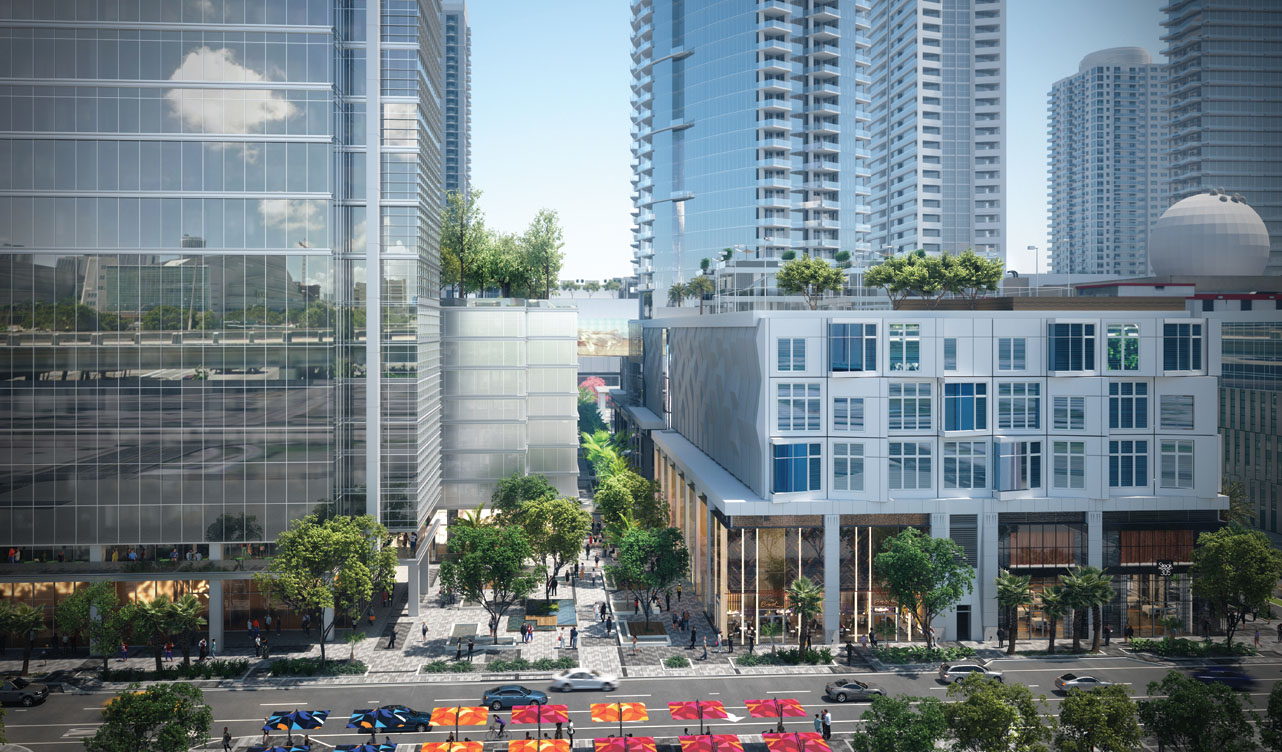
A makeover is materializing about a decade after city residents voted in November 2017 to up-zone a multiblock "Town Center" between 69th and 72nd streets, bounded by Dickens Avenue and Indian Creek Drive on the west and Collins Avenue to the east. Today, more than a half-dozen projects — mostly mixed-use residential — are in various stages of construction and development in and around that core, replacing what was primarily aging, low-rise retail buildings, surface parking and empty lots.
Law360 Real Estate Authority spoke with developer Robert Finvarb, whose firm, Robert Finvarb Companies, recently broke ground on the 15-story NoBe Parc. The Miami Beach native, who grew up in North Beach and still lives nearby, spoke about why developers largely overlooked the area, what caused that to change and how he expects the new development will help create a more vibrant neighborhood.
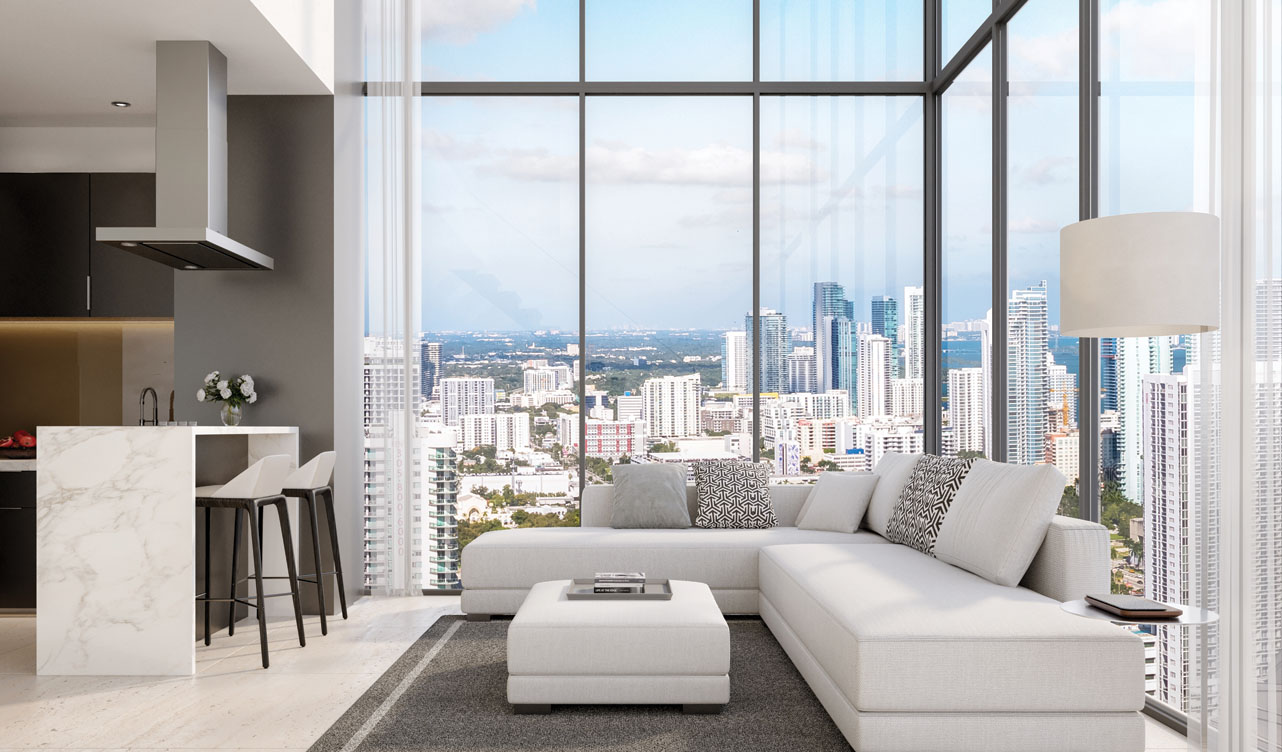
NoBe Parc, which will be located at 740 Abbott Ave., will feature 232 residential units, ranging from studios to three-bedroom units, priced from $570,000 to $2 million. They'll come fully furnished, with interior design by Venus Williams' V Starr firm and furnishings by Crate & Barrel. The units will also have permission for short-term-rental use, which is prohibited elsewhere in the city.
Other developers active in the area include Lefferts, which already completed the nearby 72 Park tower and has two more towers in the works, as well as Constellation Group and Northlink Capital. Witkoff Group has partnered with Ocean Terrace Holdings to redevelop the oceanfront Ocean Terrace block just north of the Town Center District with two luxury residences and a luxury hotel, while Miami developer David Martin's Terra Group has teamed with the Meruelo family to rebuild a modern version of the demolished Deauville Beach Resort.
This conversation has been edited for length and clarity.
I understand you grew up in North Beach? Can you lay out for us what the neighborhood was like and how it has changed over the years, and from a real estate standpoint, how it has fit in with Miami Beach as a whole?
Yeah, I grew up six blocks away from the NoBe Parc site in Biscayne Point. I went to school in North Beach until eighth grade, and other than going away to college and law school, have been living within 20 blocks of that area my entire life.
When you look at Miami Beach, South Beach has always been the hospitality-entertainment district with high-rise, upscale housing, but there's no neighborhood fabric, if you will.
Mid-Beach is anchored by 41st Street, where you've got the groceries, the drugstores, doctors' and dentists' offices, and a main artery to the mainland over the Julia Tuttle Causeway.
North Beach, honestly, hadn't changed much from how it was when I grew up. Up until 2017, it was ignored by the development community. A lot of that has to do with zoning. The buildings were very dilapidated. If you look at what's going on in Ocean Terrace, you do have to govern your way around bringing neighborhoods back to life.
One thing I've advocated for is you've got to do it in South Beach, and you've got to do it along Ocean Drive. I'm not talking about creating a Sunny Isles Beach in Ocean Drive, but you do have to incentivize development, maybe along Collins Avenue, to help bring Ocean Drive back to a better time, similar to what is transpiring in [Miami's] Coconut Grove [neighborhood].
Explain what led to the changes we're seeing now in North Beach.
For North Beach, a turning point was 2017. There was a voter referendum that up-zoned the area. It was called Town Center. And that up-zoning only happened within a very limited area. Nothing beyond that was up-zoned. Nothing beyond that was rezoned.
Basically, what you've done now is help incentivize developers to create a town center. And here, now, you're going to be able to bring in restaurants and exercise centers and coffee shops, and create vibrancy. By allowing developers to go somewhat vertical, by bringing in more condos and multifamily units that are going to bring in a younger demographic, now you're getting back to elevating North Beach into a more competitive submarket of South Florida.
I played baseball, I played tennis across the street in North Shore Park. I've seen it. You still have that same feeling in North Shore Park, and that's not changing. But what you will have now is young families that can afford to move into the area. Our property is coming in at a much lower price point than what you'll see traditional condos coming into the market at. We're priced from as low as $570,000 up to $2 million.
But nothing has changed in [neighboring] Crespi and Stillwater and Biscayne Point and Normandy Isle. All that continues to develop and evolve, and there are still great neighborhoods. But now, you're going to have some great places for everybody that lives in Mid-Beach and North Beach to dine and to live on a 24/7 basis, and not have to get in your car and drive to Surfside or Bal Harbor or South Beach or Wynwood or the Design District to get some basic services like what you're accustomed to doing these days.
To get a little more technical about the rezoning, what was allowed before, and what changed that made the big difference?
You could only build three or four stories.
So, a lot of it was the verticality that is now allowed?
One hundred percent. The verticality and also the ability to allow for short-term rentals within this very compressed area.
Because the city doesn't allow short-term rentals, generally speaking, right?
Correct. They're limited to this area.
Honestly, I'm a hotel guy. I've developed 25 hotels around the United States. I would never develop a hotel in this area, because you don't have that tourist draw, and you don't have the business draw. So, all you have really is residential.
Talk about the mixed-use aspect of this current development. There was various retail space in the area, but how does ground-floor retail come into play with these new projects?
Every single project, I believe, has ground-floor retail. We're going to have about 12,000 to 13,000 feet of ground-floor retail, and we'll be very intentional in terms of the uses that we bring in.
I know 72 Park, the project to the west of us, has ground-floor retail. They actually opened up a steakhouse that's doing very well. That was a product type that wasn't necessarily existing there. I know the Pacific Star Capital project to my south will have a substantial amount of retail. So, the intent among all the developers in the area is to create a significant amount of pedestrian traffic.
And I'm going to give you an example of what was replaced when we scraped the existing improvements. We replaced a laundromat. Laundromats are not areas that attract. I mean there was drug trade. There was crazy stuff. We had to shut it down. And then next door to the laundromat, we had a flea market type of property. And then, next to that, there was a one-story HMO. I mean, it's not like there was any vibrancy there.
So, as you said, the rezoning, which was approved in 2017 and enacted the following year, was a trigger to allow for this kind of development. Could you speak about the timing and why we're seeing this development actually happening now? Obviously, South Florida has been booming, and the village of Surfside just to the north has seen a lot of development attention, too, maybe in some different ways.
The 2017 referendum was the impetus. Now, there's critical mass. I think there's at least eight or nine private development projects in the pipeline. I mentioned 72 Park. Lefferts is also doing Palma. And there are several other projects, including NoBe Parc. So, now it makes economic sense to go vertical.
But again, North Beach always had the right elements and ingredients to be successful. The beach is amazing. It's a wide beach. The band shell is an incredible amenity to all of Miami Beach, not just North Beach. The area has a tremendous amount of character, in terms of Argentinian food and Italian food and Cuban food. It's very accessible from the 79th Street Causeway or if you want to just hit the Julia Tuttle [Causeway].
But what happened was investment passed it by, because it wasn't conducive to develop three-story buildings. You can't afford to do it in this environment where you're competing with all these high-rise condos and office buildings over the same construction resources. It just doesn't work.
Now what you're doing is sort of elevating the Town Center, this small radius, and it's going to have a halo effect over all of North Beach that's going to allow it to realize the growth the rest of South Florida has seen.
How long have you owned the NoBe Parc site? And did you assemble multiple properties?
I've owned the property for over 10 years. We bought properties from six different owners.
I know your company has been focused on hotels and marinas in the past. Is this your first condo or residential project? Why did you choose to take this on?
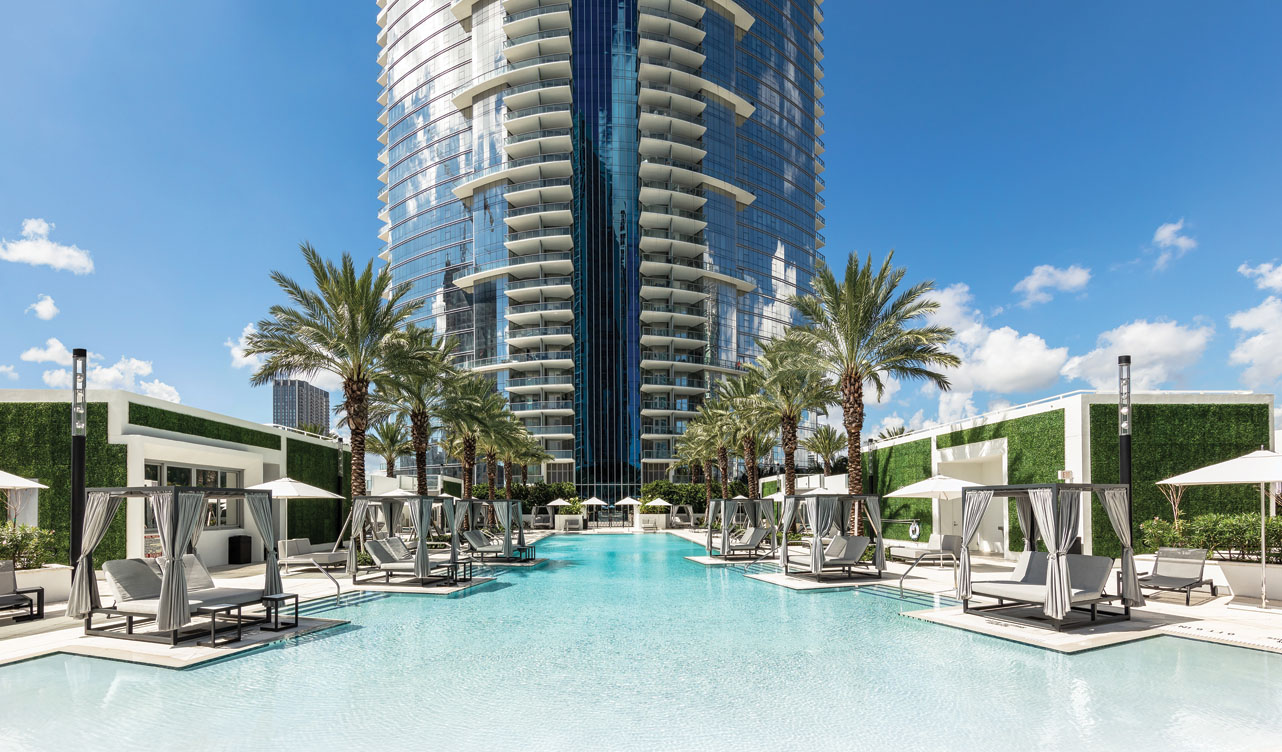
Yeah, because I know this is something North Beach is sort of missing. I've got a tremendous amount of experience in terms of developing projects that are destinations unto themselves, and being able to apply those learnings to this project and make this an exciting place to live with great amenities — cold plunge, saunas, world-class gym, rooftop, curating the retail in the right way — is extremely exciting. And for me, personally, to do it in my backyard where I grew up, it's sort of a full-circle moment for me.
With those amenities you mentioned, it sounds like that's a way you've drawn on your hospitality experience. What are some other key decisions you made with NoBe Parc? You mentioned the short-term rental flexibility, and I saw it's going to have fully furnished units. What was your thinking on those?
I'm basically doing everything I've done in a hotel. I'm fully furnishing it. [Architectural firm] Arquitectonica designed the building, so it's a world-class design. The interior design is by V Starr, which is actually owned by Venus Williams. Given the connection to the tennis center in Miami Beach across the street, I thought that was a cool connection. All the units are furnished by Crate & Barrel. All you need to do is bring your toothbrush, and you're ready to go. It's more of a true turnkey experience as opposed to having to deal with a raw space and fighting for the same resources that everybody's fighting for in terms of getting contractors to work for you.
In terms of your own vision and looking at the collection of other projects that are going up around yours and who's involved in developing those, how would you describe what this neighborhood will become and who do you expect to be here?
North Beach is still going to be a neighborhood. It's still going to be residential. It's still going to be families. It's not going to be South Beach. My profile of retail tenant is completely different than what it is in South Beach.
It's going to be more for moms and dads and kids to go to a juice bar or coffee shop or an exercise facility or an approachable type of restaurant.
It's more livable. There's less transient type of movement. I just think that was missing, and I feel like whether you were driving south on Abbott Avenue or north on Collins Avenue, it was literally, other than stopping to get gas or stopping at one or two restaurants, it didn't have a reason for you to stop.
Having lived here my entire life, I want to try and do things that get cars off the road. If you're in Mid-Beach, if you've got a great restaurant that you can take a 10-minute drive to and not have to drive across the Julia Tuttle into Wynwood and all this, it's one less car that's on the road. That's the way I'm looking at it.
Is there anything else you think the neighborhood is missing or that is needed to really realize its potential?
No, I think it's happening. I think you're going to see a gourmet grocer. You're going to see some approachable, affordable new [food and beverage] destinations and other places. The connectivity from Bal Harbor to South Pointe along the boardwalk is so awesome. And again, just really capitalizing on the exceptional natural amenities that are at our doorstep.
How do you see this affecting affordability in the area — not just for the exact Town Center District, but some of the surrounding neighborhoods you mentioned as well?
I think North Beach is the most affordable pocket in Miami Beach. Being that I'm a native, I understand the importance of it, and we've been very intentional. You're going to get a lot for your money.
The smaller unit size at the lower price points, and the ability to generate a return if you're not living in it is how I've tried to address those issues.
What role has the city played, or what has your interaction been like with the city in the development process?
The city's been great. Everybody's been great. They've been very intentional in terms of wanting this to succeed.
--Editing by Lakshna Mehta.